The People’s Kings
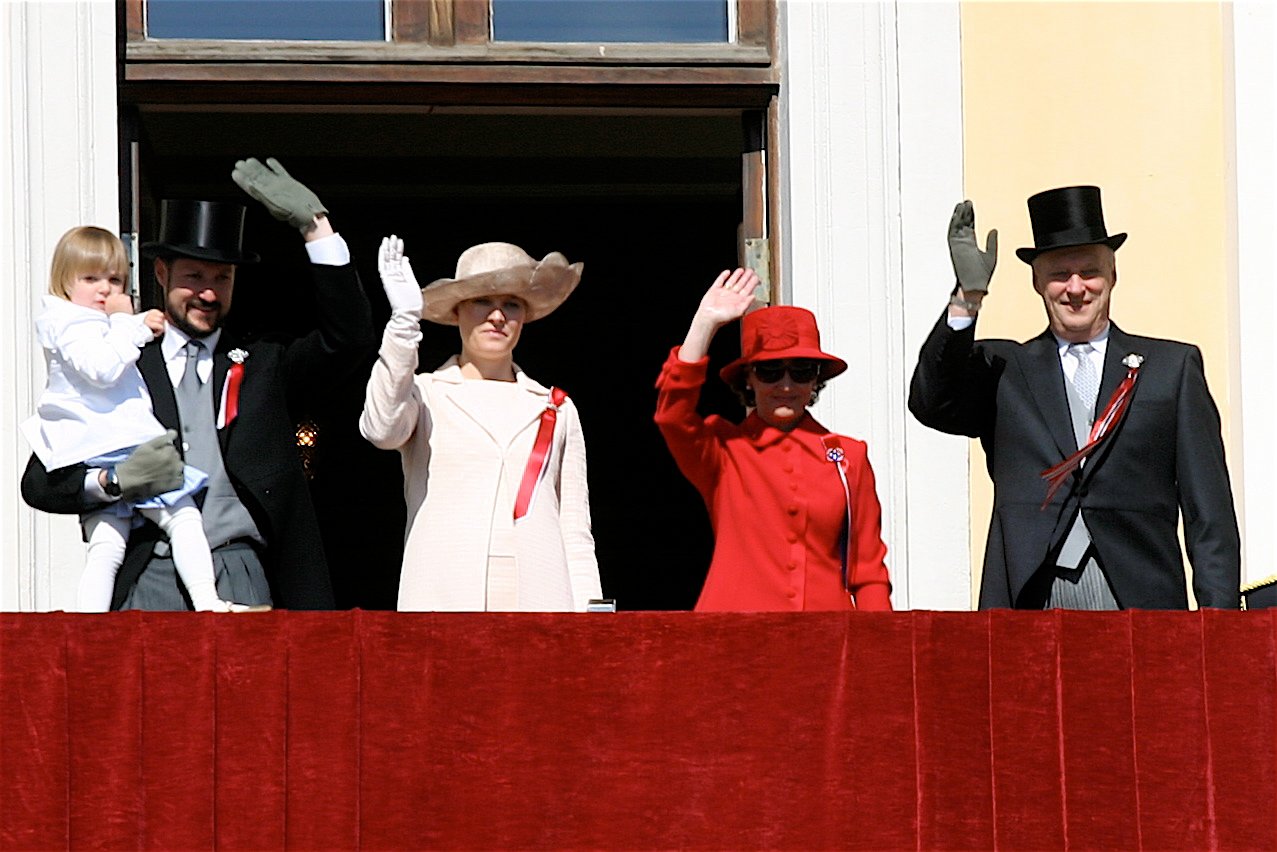
The Norwegian Royal Family, Oslo, May 17, 2007. Princess Ingrid-Alexandra, Crown Prince Haakon, Crown Princess Mette-Marit, Queen Sonja, King Haakon V. (Photo by Ernst Vikne/Creative Commons).
For centuries, Europe was ruled by monarchs. Subjects were at the mercy of their regent, who had exclusive control over both people and land. But today, only 25 percent of European nations still recognize a royal family. With the exception of the Vatican, all current monarchies are constitutional, meaning they hold minimal power, and their role is primarily historical and ceremonial in function. Three Scandinavian countries continue the monarchist tradition: Denmark, Sweden and Norway.
When referencing the Middle Ages, facts often blur with legend, but Harald I (Harald Fairhair) is widely believed to have been the first king of Norway. He was a Viking ruler, famous for uniting the numerous chiefs into one kingdom around 872 A.D. A century and a half later, King Olaf II transitioned the country from paganism to Christianity in 1024 A.D. The year following his death upon the battlefield, he became canonized as Saint Olaf, the patron saint of Norway.
Denmark, Sweden, and Norway have a long, intertwined, political history. While Denmark and Sweden have held continuous monarchs for over a thousand years, Norway lost its sovereignty to Denmark from 1380 to 1814. This occurred when Olav IV inherited both the Danish and Norwegian crowns concurrently—first Demark through his maternal grandfather, followed by Norway’s kingdom four years later upon his father’s passing. When he died suddenly as a teenager, he left no heirs. This ended the Norwegian royal line of succession and passed the crown to his first cousin of Denmark, where it was held for the following four centuries, an era known as the “400-Year Night.”
The Napoleonic Wars reshaped the Scandinavian geopolitical map and broke Denmark’s reign over Norway. Denmark, a French ally, lost the war and was forced to surrender its control of Norway, which was then ceded to Sweden under the Treaty of Kiel. Tired of being tossed between Denmark and Sweden, they established their own constitution and parliament in a declaration of once again becoming an independent, sovereign nation. The signing of Norway’s constitution, on May 17, 1814, is celebrated by Norwegians as Constitution Day (Syttende Mai).
A brief war for independence occurred over the summer of 1814, but due to Norway’s lack of a strong military or of ample resources, it was forced into a union with Sweden. After 400 years of living under the Kingdom of Denmark, Norway was placed under the Swedish Crown. During this period, the two countries shared a monarch and foreign policy, but Norway maintained its own constitution, laws, currency, and military.
In 1905, the union between Sweden and Norway was permanently dissolved through peaceful negotiation. One of the first acts of the Storting (the Norwegian parliament) was to elect a king. They chose Prince Carl, the 32-year-old grandson of the sitting king of Denmark. He was selected, in part, due to having half Danish and half Swedish heritage. Others factors that positively influenced the decision were his young age, his strong belief in democracy, and his marriage to Maud, the daughter of King Edward VII of Great Britain, a significant military power.
Prince Carl refused to accept the crown unless the Norwegian people agreed to having a king. A vote of the people was taken, and 79 percent voted in favor of re-establishing the Kingdom. Carl chose a symbolic name upon his ascension; in honor of King Haakon VI, the last independent king of Norway who reigned 500 years prior, he chose the name King Haakon VII.
Haakon VII was beloved by the people of Norway. He was highly respected for his resilience and defiance against Germany during World War 2. On April 9, 1940, Germany invaded Norway and within days defeat was inevitable. The King famously vowed he would abdicate the throne versus surrender to the enemy. With Nazi forces closing in, he and the royal family, along with the country’s 49-ton gold reserve, narrowly escaped in time. From Londen, King Haakon maintained contact with the Storting and regularly gave uplifting speeches to the Norwegian people over BBC radio. The 2016 war-biography film The King’s Choice highlights the invasion of Norway and the ensuing days that followed. It showcases the king’s most difficult decision of his lifetime: to abdicate the throne and face possible death at the hands of the Germans or to evacuate and lead his people from abroad.
After the Allied Powers prevailed, the king returned home to Norway, exactly five years to the day he escaped. He was welcomed with a historic jubilee and parade. For the remainder of his life, he was instrumental in reconstructing his nation and helped bring it into the modern era. In 1957, at 85 years old, King Haakon VII passed away peacefully at the Royal Palace in Oslo.
The king’s only child, Crown Prince Olav, was two years old when his father famously carried him down the gangway upon their arrival to Norwegian shores in 1905. In his youth, the prince was a remarkable skier and sailor, winning a gold medal in sailing at the 1928 Olympics. After he graduated from the Norwegian Military Academy, he studied at Oxford before his wedding to Princess Märtha of Sweden, in 1929. The couple had two daughters followed by a son, Harald, Norway’s current king.
During the horrific early days of WW2, the crown prince tried to stay behind to fight in the mountains. After being convinced that he was too valuable to the nation, he and the king escaped to London where they were protected for the duration of the war. While in exile, Olav was a chief advisor to the Norwegian armed forces operating out of London and to the resistance movement back home.
King Olav V ascended the throne in 1957 after the passing of his father. Olav’s beloved wife, Märtha, died three years before her husband’s coronation. The grieving king never remarried. Like his father, Olav was much beloved by the Norwegian people. He became universally known as “The People’s King”, for his unassuming, down-to-earth nature. He regularly used public transportation, drove his own vehicle, and traveled without bodyguards. When asked why, he famously stated, “I have four million bodyguards,” referring to the Norwegian people.
Olav V was the first Norwegian king to visit Minnesota. In 1968, he visited St. Olaf College in Northfield, where he received the St. Olaf Centennial Medal. He returned to Minneapolis in 1975, and to Concordia College in Moorhead in 1982. His final trip to the United States was in November 1987. He again visited St. Olaf’s College, and the next day had the pleasure of experiencing an American Thanksgiving as a guest at a private home in Edina. A visit to Augsburg College in Minneapolis ended his trip to Minnesota. A stop in Decorah, Iowa followed by a visit with President Reagan in Washington D.C. concluded his final visit to the United States.
King Olav V died in 1991 of a heart attack just outside of Oslo. He was 87 years old. Upon hearing the news, thousands of mourners gathered by candlelight in the snowy square outside the palace. During his funeral procession, over 100,000 Norwegians silently lined the streets of Oslo to pay respects to their beloved king. The Kingdom of Norway was then passed to his son, Harald.
King Harald V, the current king, was just three years old when his family fled the Nazis. He, his two older sisters, and their mother narrowly managed to cross the border into neutral Sweden, the birthplace of his mother Märtha. Four months later, the family traveled by army escort aboard the SS American Legion to the United States where they sheltered in the Washington D.C. area for the duration of the war. During his childhood in the U.S., he became fluent in English.
Young Harald made history when he became the first member of the royal family to attend public school. In 1945, after returning home at the conclusion of the war, he enrolled in the third grade at Smestad Skol in Oslo. He graduated high school at Oslo Cathedral School then attended the University of Oslo. Following university, he graduated from the Norwegian Military Academy like his father.
Harald met his future bride, Sonia, in 1959 at a private party of a mutual friend. Sonia was a commoner, the daughter of a clothing merchant. The couple fell in love and wanted to marry, however strict royal traditions forbid marriages between royalty and commoners. Harald vowed that if he could not marry Sonia, he would never marry at all, which would then end the royal line. Both the press and the Norwegian government feared that the public would repudiate the union, but the people warmly accepted Queen Sonia, and the couple remain greatly admired to this day. Harald and Sonia’s two children—Märtha, born in 1971, and Crown Prince Haakon, born in 1973—are both named after their paternal grandparents.
Following the legacies of both his father and grandfather, King Harald V is the third successive king to be known for his connection to the people. He is highly respected and admired for his approachability and humility. He has an inclusive worldview, values transparency, and is known to have a genuine sense of humor. He equitably gives commoners access to royal properties and includes them in royal functions. He is greatly dedicated to public service and is a patron of many Norwegian non-profits and charities, including the Norwegian Cancer Society.
The aging king is currently 89 years old, and is the oldest reigning monarch in Europe. He has lived longer than both his father and grandfather. Upon his death, his son will become King Haakon VIII. In 1990, following the lead of Sweden and the Netherlands, a change was made to the Norwegian constitution. This significant new law allowed daughters, born after 1990, to be included in the royal line of succession; a system known as absolute primogeniture. When Haakon’s daughter, Ingrid Alexandra, inherits the throne, she will become Norway’s first reigning queen in over 600 years.
Because the current independent line of the Norwegian crown didn’t begin until 1905, the last three kings of Norway are one of the most recent royal bloodlines in the world. All European monarchies of today have eliminated their archaic systems of pomp and circumstance, and have embraced their modern role as public servants. This evolution stems from a changing world where democracy is now king. Today, the entire existence of monarchs depends solely upon their societal acceptance by tax-paying citizens. This widespread shift has only occurred within the last generation, but the three “People’s Kings” of Norway had adopted this philosophy from the onset of independence. They were the first to lead the definition of a modern monarchy.
☕ If you enjoyed this article, please buy me a cup of ‘kaffe’ to support my work. ☕